

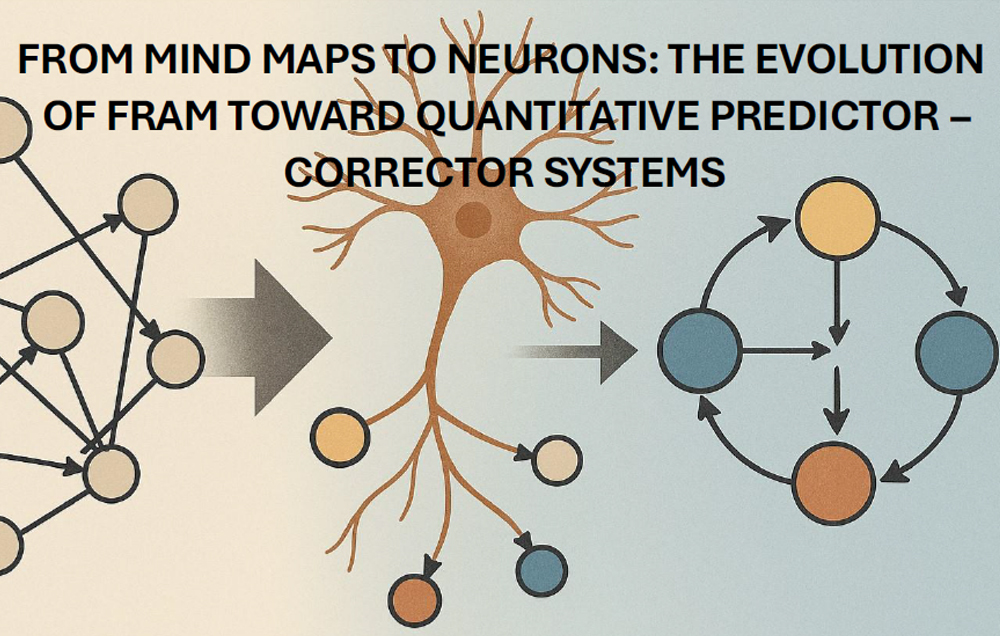
Abstract This article traces the evolution of the Functional Resonance Analysis Method (FRAM) from its early role as a qualitative “mind map” of sociotechnical variability, through its analogy with neuronal and cognitive architectures, to its current development as a quantitative predictor–corrector framework. We demonstrate how FRAM can operationalise John Boyd’s OODA loop in the context of aircraft landing, modelling Observe, Orient, Decide, and Act not as abstract stages but as interdependent functions with measurable properties. Predictor–corrector dynamics, residuals between predicted and observed values, and doctrinal gates are encoded directly in metadata, enabling decision to be treated as a quantifiable process rather than a black box. Extending Llinás’s framework for situation control, the Orient phase is decomposed into functions that incorporate memory, doctrine, and cognitive filters alongside sensor fusion. Results show that FRAM can generate traceable time series of OODA activity, enforce stabilisation barriers, and reveal how decision restores congruity under stress. The approach demonstrates both the potential and the limitations of quantification, offering a credible pathway from metaphor to model in the analysis of decision-making within complex sociotechnical systems.
Key words – Functional Resonance Analysis Method (FRAM); OODA loop; predictor–corrector; decision-making; situation awareness; aircraft landing; sociotechnical systems; variability; metadata modelling; resilience engineering.