

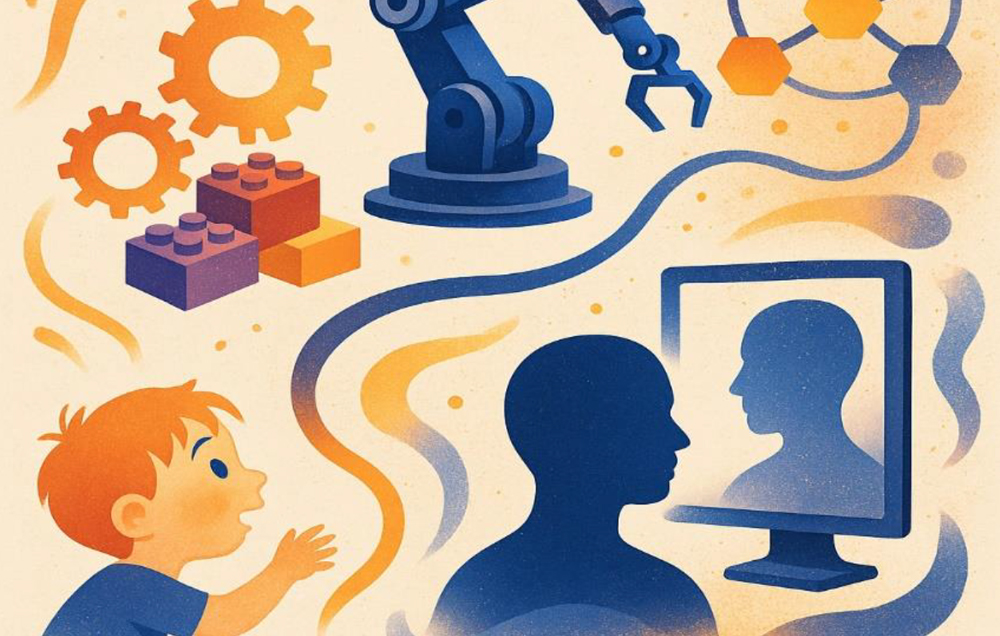
INTRODUCTION — FROM CURIOSITY TO COMPLEXITY
When we first encounter the world, we do so like a child taking its first steps — seeing, touching, sensing, and asking the simplest of questions: What is it? How does it work? Why does it do that? These are the same questions that drive all human understanding, from early wonder at how toys move to the most sophisticated explorations of how societies and technologies function.
At first, the WHAT is tangible. A child learns that blocks fit together, that pushing a ball makes it roll, that pressing a lever releases a spring. The HOW emerges through play — through experimenting with things that can be touched and seen. We learn by building models: bricks, Lego, Meccano — small, hands-on systems that reveal cause and effect. These are our first experiments in reasoning about function.
As machines appeared, that same curiosity evolved into engineering. Early engineers were pragmatic thinkers, focused on keeping machines running. They needed to know how mechanisms worked, not necessarily WHY. The goal was to make systems reliable — to maintain function when parts failed, and to restore it when they broke. Analytical tools such as Failure Modes and Effects Analysis (FMEA) and Fault Tree Analysis (FTA) emerged from this mechanical mindset. They decomposed systems into components and traced how failures propagated to effects.
But humans were never components. When people entered the system — as operators, decision-makers, and designers — the simple model of cause and effect began to fracture. Unlike a valve, or a gear, a person’s performance can vary with context, fatigue, or ambiguity. This variability could not be diagrammed in logic trees. Written procedures tried to codify human work, but they captured only the what and how, never the why. Once human and social factors entered the picture, systems became complex, not merely complicated.